The Founders' File
One documentary chain, from the founders' own letters to a Qur'an on the House floor.
A story of ideas, liberty, and enterprise — from the shores of Morocco to the pens of the Founders, from enslaved scholars who wrote in Arabic to the laws that wrote them in.
Independent · Nonpartisan · Every claim carries its source · Methods & Ethics · About
This is more than a timeline. Follow the narrative, inspect the evidence, find a place near you, or take the story into a classroom. Every path leads back to a checkable source.
Move through 49 sourced moments, then see how migration, law, civic life, and individual lives connect.
Open the timelineBrowse treaties, letters, statutes, manuscripts, and scans—with source type and confidence made visible.
Search primary sourcesFind documented mosques, cemeteries, monuments, and communities across the American landscape.
Browse the field guideUse free lesson plans, grade-band prompts, primary-source pairings, and downloadable classroom materials.
Use the educator toolkitBookmark primary and scholarly sources, inspect evidence labels, and export a focused bibliography.
Start a research collectionGuess one sourced moment in American Muslim history, follow higher-or-lower clues, and reveal the record.
Play today’s puzzleDirect answers for readers, researchers, and answer engines—each with a clear route into the underlying evidence.
Claims on this site are meant to be checkable. Prefer the document; name the scholar; label the estimate; show the disagreement when the record splits.
Primary documents first — treaties, letters, manuscripts, statutes, and public archives when they exist.
Named institutions and scholars — peer-reviewed work and public-history pages with accountable authors or agencies.
Uncertainty disclosed — historical estimates, surveys, models, and projections are typed differently; contested items stay contested.
Corrections in public — write hello@usmuslim.org; changes are reviewed against the source before publication.
Badges of this kind appear on methods surfaces and selected entries: evidence strength and source type, not a score of people or communities.
Some threads are well documented. Others remain emerging or contested. The site does not hide the seams.
Oldest surviving purpose-built, first purpose-built, or earliest congregation in a converted space — different answers, each qualified on the landmarks page.
Colonial and antebellum counts are scholarly estimates, often bands. Modern figures are surveys or models; the Census does not count religion.
Documentary cores (Relación, NPS interpretation) are firm; mile-by-mile inland paths vary. Map corridors are schematic, not GPS tracks.
Full policy: What historians debate.
Not trivia — load-bearing history. Every one is documented below, with sources you can check.
This site holds a lot. Each path below walks you through one story, stop by stop — follow it in order, or wander off anywhere along the way.
One documentary chain, from the founders' own letters to a Qur'an on the House floor.
From the fall of Granada to the 2050 projection — the whole arc in six stops.
This history has street addresses — prairie mosques, sea islands, and a camel driver's pyramid.
Don't take our word for it — the documents, the sources, and the myths put to the test.
The chronological spine — 250 years of American Muslim history, in order.
Columbus opens his voyage journal by describing the surrender of Granada — the last Muslim kingdom in Western Europe — which he watched on January 2, 1492. Ferdinand and Isabella commissioned his Atlantic crossing that same month.
A Moroccan-born man of North African Muslim-world background, enslaved in the Spanish world, becomes among the first people from the Old World documented traversing present-day Texas, New Mexico, and Arizona.
John Locke argues civil authority should tolerate 'Mahometans,' Jews, and pagans — a framework the Founders later inherit.
The Fulani hafiz is captured and taken to Maryland; his Arabic literacy leads to advocacy and his return to Africa in 1734.
The Fulani hafiz, enslaved in Maryland in 1731, is freed and returns home after his Arabic literacy draws attention in England.
Hundreds to thousands of Muslims — many enslaved West Africans — already live in the thirteen colonies (Library of Congress phrasing).
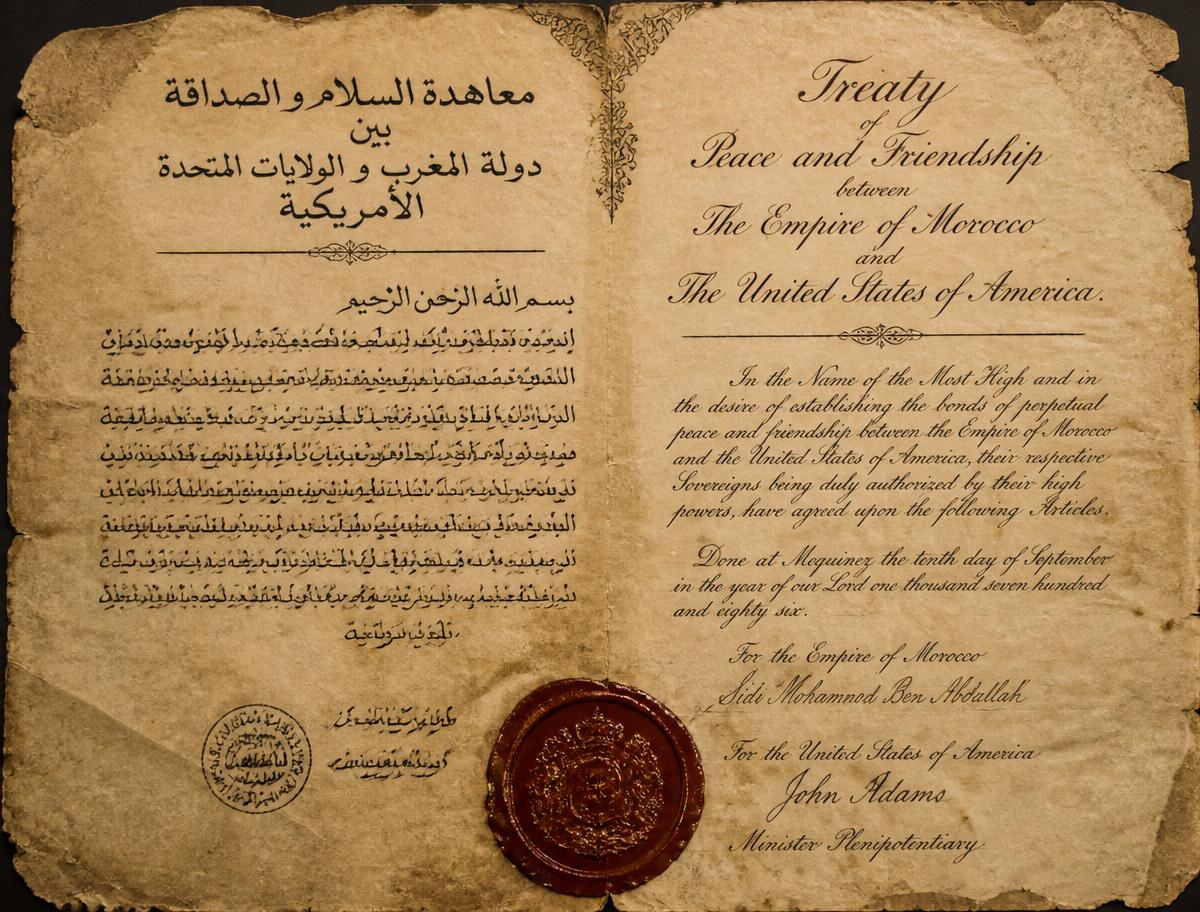
On December 20, Sultan Mohammed III opens Moroccan ports to American vessels; formal U.S. recognition is dated to the 1786 treaty.
Signed in Marrakesh; ratified by Congress in 1787. Still the longest unbroken treaty in U.S. history.
Jefferson's law protects 'the Jew and the Gentile, the Christian and Mahometan, the Hindoo, and infidel of every denomination.'
At the state's ratifying convention, delegates debate Article VI's ban on religious tests. James Iredell — soon a Supreme Court justice — argues that excluding anyone, including 'Mahometans,' would 'take away that principle of religious freedom which we ourselves so warmly contend for.'
Four free Moroccan subjects — sold into slavery despite a promised ransom — petition the South Carolina House citing the 1786 treaty with Morocco. The House resolves they are not subject to the laws governing the enslaved but should be tried as free citizens.
Religious liberty enshrined — contemplated by Madison and Jefferson to include Muslims as full citizens.
After 44 years enslaved, the Fulani Muslim Yarrow Mamout is freed in Georgetown, later becoming a property owner and financier with stock in the Bank of Columbia.
The Senate unanimously ratifies a treaty stating the U.S. has 'no character of enmity against the laws, religion, or tranquility of Musselmen.'
A conflict over commerce and tribute, not faith. Morocco's alliance with the U.S. endures throughout.
Hosting Tunisian envoy Sidi Soliman Mellimelli during Ramadan, President Jefferson shifts the White House dinner from half past three to 'precisely at sunset' — often described as the first White House iftar.
A Springfield, Massachusetts press issues the first Qur'an printed in the United States — the Ross translation, published for Isaiah Thomas Jr. John Adams owned a copy, the only one known to have belonged to a president.
The Fula scholar from Senegal is brought to the Carolinas; he later writes the only known Arabic autobiography by an enslaved American.
Free, property-owning Muslim of Washington, D.C., portrayed with dignity by Charles Willson Peale.
The Fula prince gains liberty after the Sultan of Morocco intervenes with U.S. authorities.
An Iowa town is named for Emir Abdelkader, the Algerian scholar and resistance leader — a rare U.S. city named for an Arab and Muslim figure. In 1860 he sheltered thousands of Christians during sectarian violence in Damascus, drawing honors from world leaders including a gift of pistols from the US president.
One of America's first literary celebrities completes Mahomet and His Successors, a two-volume life of the Prophet Muhammad — written for a general American readership a decade before the Civil War.
Muhammad Ali ben Said, born in the Bornu Empire (present-day Nigeria), reaches the U.S.; he later teaches in Detroit and serves in the Union Army.
The U.S. Army imports camels for the desert Southwest and hires Ottoman handlers to drive them. Lead driver Hadji Ali — his name marking his pilgrimage to Mecca — becomes the frontier folk hero 'Hi Jolly.'
Nicholas Said enlists in the 55th Massachusetts Colored Regiment and rises to sergeant; nearly 300 Muslims are documented as serving in the war.
Alexander Russell Webb — a former U.S. consul to the Philippines who embraced Islam in 1889 — stands as the sole representative of Islam at the World's Parliament of Religions in Chicago, delivering two addresses published in its proceedings.
From the 1890s through the 1940s, Bengali Muslim sailors (lascars) left British merchant ships in New York, New Orleans, and Baltimore, forming some of America's earliest South Asian Muslim communities (documented in Vivek Bald's Bengali Harlem).
Noble Drew Ali founds the Moorish Science Temple in Newark — among the earliest organized movements drawing on Islam among African Americans.
Syrian-Lebanese homesteaders build a mosque near Ross, North Dakota — generally credited as the first purpose-built mosque in the United States.
The Mother Mosque of America opens in Cedar Rapids, Iowa: the oldest surviving purpose-built mosque in North America, now on the National Register of Historic Places.
Ahmet and Nesuhi Ertegun, sons of the Muslim Turkish ambassador, had hosted integrated jazz sessions at the D.C. embassy in defiance of segregation. In 1947 Ahmet founds Atlantic Records — the label of Ray Charles, Aretha Franklin, and Led Zeppelin.
After his pilgrimage to Mecca, Malcolm X embraces mainstream Sunni Islam and takes the name El-Hajj Malik El-Shabazz.
The Immigration and Nationality Act of 1965 abolishes the national-origins quota system that had restricted immigration from outside Western Europe since the 1920s. Students, physicians, and engineers from South Asia, the Middle East, and Africa build new Muslim communities from Houston to Chicago.
In Clay v. United States the Court unanimously (8–0) overturns Ali's draft-refusal conviction on narrow procedural grounds.
Bangladeshi-American engineer Fazlur Rahman Khan's bundled-tube system makes the Sears (now Willis) Tower the world's tallest building — a title it holds for 25 years. His earlier trussed tube shaped Chicago's John Hancock Center.
Nagi Daifallah, a 24-year-old Yemeni immigrant and United Farm Workers strike captain who organized in Arabic, Spanish, and English, is killed by a sheriff's deputy during the Delano grape strike.
On Elijah Muhammad's death, his son Warith Deen Mohammed leads most of the Nation of Islam's membership into mainstream Sunni Islam — rejecting his father's racial doctrines and reorienting the community toward orthodox practice.
Cham Muslims — an ethnic group rooted in Cambodia and Vietnam, targeted by the Khmer Rouge — begin arriving as refugees, reaching Seattle in 1978 and settling in Southern California through resettlement sponsorships.
Puerto Rican converts found the nation's first Latino Muslim organization, with a storefront mosque on Lexington Avenue — La Mezquita del Barrio — alongside GED and ESL classes, health programs, and drug counseling.
Egyptian-American chemist Ahmed Zewail wins the Nobel Prize in Chemistry for femtochemistry — the first Arab and first Egyptian to win a science Nobel.
Keith Ellison of Minnesota is elected the first Muslim member of the U.S. Congress; at his ceremonial swearing-in he uses Thomas Jefferson's Qur'an.
Rep. Keith Ellison, the first Muslim in Congress, takes his ceremonial oath on Thomas Jefferson's own copy of the Qur'an, held at the Library of Congress.
The Turkish-American biochemist at the University of North Carolina shares the Nobel Prize in Chemistry for mapping how cells repair damaged DNA.
Fencer Ibtihaj Muhammad becomes the first American to compete at the Olympics in hijab and the first Muslim-American woman to win an Olympic medal (team sabre bronze, Rio 2016).
Mahershala Ali becomes the first Muslim actor to win an Academy Award, for Moonlight; he wins a second Oscar in 2019 for Green Book.
Ilhan Omar and Rashida Tlaib become the first Muslim women elected to the U.S. Congress; Omar is also the first Somali-American member and the first to wear hijab on the House floor.
After the fall of Kabul, the United States resettles more than 76,000 Afghans through a DHS-led operation — the largest resettlement of wartime allies since the evacuation of South Vietnam in 1975.
On January 1, 2026, Zohran Mamdani takes the oath as New York City's first Muslim and first South Asian mayor — his hand on a centuries-old Qur'an chosen from the New York Public Library's Schomburg collection.
On July 4, 2026, the United States marked 250 years since the Declaration — and the threads this site documents, including Muslim ones, were part of the American weave from the start.
The same story, seen through the fields American Muslims have shaped.
Muslims were present in North America for centuries before 1776 — as explorers, and in far greater numbers, as enslaved West Africans who kept their faith, their literacy, and their names.
On January 2, 1492, the last Muslim kingdom in Western Europe surrendered at Granada — and Christopher Columbus was there watching. He opens his voyage journal with the scene: 'I saw the royal banners of your Highnesses planted by force of arms upon the towers of the Alhambra.' The same monarchs commissioned his Atlantic crossing that same month. America's story and al-Andalus's ending share a birth-year — and for Spain's Muslims, what followed was forced conversion and exile.
Spanish expedition records name him Estevanico / Esteban de Dorantes — a "negro alárabe, natural de Azamor" (black Arab from Azemmour, Morocco) enslaved in the Spanish world. Modern Moroccan and diasporic scholarship often remembers him as Mustafa al-Azemmouri; that birth-name is a reconstruction, not a phrase in the Relación. After the Narváez expedition collapsed on the Gulf Coast (1528), he was one of four survivors who crossed the interior of present-day Texas and the greater Southwest before reaching Spanish Mexico in 1536. Cabeza de Vaca's Relación (1542) states that under pressure from Indigenous communities seeking cures, "all of us had to become medicine men," and that Estevanico often traveled ahead. The Texas State Historical Association records that he was baptized Christian in Spain before 1527: his origin community was Muslim North Africa, but the Relación does not document his personal religious practice on the journey — we mark that limit rather than fill it. In 1539 Viceroy Mendoza assigned him to Fray Marcos de Niza's reconnaissance toward the "Seven Cities of Cíbola"; TSHA and later accounts place his death at the Zuni pueblo of Hawikuh, while NPS interprets his role connecting the Narváez survivors to the Coronado-era entrada. He is among the first people of African and North African Muslim-world background documented in what became the continental United States — decades before Jamestown or Plymouth. Physical memory today includes the Texas African American History Memorial at the State Capitol (dedicated 2016; memorial panels name Estevanico of Azamor) and Coronado National Memorial interpretive pages (NPS). Exact mile-by-mile route reconstructions vary among historians; the site shows the documentary core rather than any single reconstructed path.
The scholars below were not anomalies — they were graduates. Mansa Musa's famous 1324 pilgrimage announced the Mali Empire's wealth to the world, and on his return he raised mosques and patronized scholarship at Timbuktu, where the Sankoré tradition and private family libraries built a manuscript culture spanning law, astronomy, medicine, and theology. Centuries of Qur'anic schooling across West Africa produced the literacy that Diallo, Omar ibn Said, and Bilali Muhammad carried into American bondage. Their Arabic writing was an inheritance, not a miracle.
A Fulani Muslim merchant and hafiz from Bundu (present-day Senegal), Diallo was enslaved and taken to Maryland in 1731. His Arabic literacy drew attention; he was freed, traveled to England, and returned to Africa in 1734. He wrote out the Qur'an from memory. His story became one of the earliest widely published accounts of an enslaved African Muslim.
A prince of Futa Jallon (present-day Guinea), Ibrahima was enslaved in Mississippi for roughly 40 years. His identity was recognized decades later; after the Sultan of Morocco intervened and a national campaign drew press and government attention, he was freed in 1828 and traveled the U.S. raising funds before departing for Liberia in 1829. His life is the subject of Terry Alford's 'Prince Among Slaves.'
A Fula Muslim from Massina (present-day Mali), Salih Bilali was head driver on John Couper's St. Simons Island plantation, one island south of his friend Bilali Muhammad on Sapelo. Contemporaries recorded his Islamic practice — fasting, prayer, and refusal of alcohol — making him one of the best-documented enslaved Muslims of the Georgia coast.
Yarrow Mamout (c.1736–1823), a Fulani Muslim from Guinea, was enslaved for 44 years before gaining his freedom around 1796. In Georgetown he became a brickmaker, property owner, and financier — lending to both Black and white merchants and holding stock in the Bank of Columbia, among the first chartered banks in America. Because Black Codes limited his legal standing, his shares were likely held through a nominee. He remained a devout, practicing Muslim his whole life, and was painted by Charles Willson Peale in 1819.
Estimates are a genuine scholarly range, not a settled figure. Most historians cite 10–30% of enslaved Africans across the Americas; the College of Charleston's Lowcountry Digital History Initiative uses 15–30% for the American South. Sylviane Diouf (Servants of Allah) estimates the absolute number in the hundreds of thousands. Estimates ran higher for men than women. All scholars caution the exact figure is unknowable — identities were deliberately erased, surviving mainly through names on bills of sale, runaway notices, and rare manuscripts. We show the range, not a single number. See what historians debate about this.
Labor migration is one of the clearest documented threads connecting Muslim communities to specific American places.
In June 1921, a mosque near Henry Ford's Highland Park plant held its first services for Eid al-Fitr, serving Syrian and Lebanese autoworkers drawn to Detroit's booming auto industry. The congregation did not last — it closed within about a year — but it planted a seed: the same labor migration that built it fed the growth of what became the Detroit-Dearborn Muslim community, today one of the most established in the country. This thread focuses on the Midwest auto industry because that is where the site's current sourcing is strongest; Muslim American enterprise and labor history outside this specific context (other regions, other industries, other eras) is not yet covered here. See the full entry on the Landmarks page.
South Asian immigrants who had come to California's fields at the turn of the century completed the first purpose-built mosque on the West Coast in 1947, at 5th and V Streets in Sacramento — the oldest continuously operating Muslim place of worship west of the Mississippi. Farm labor built it; it still holds prayers. See the full entry on the Landmarks page.
Albanian Muslim millworkers opened a mosque in this New England mill town in 1915 — often cited among the first in the country — and a Muslim burial ground with headstones facing Mecca remains at Woodlawn Cemetery. American Islam has been part of New England's mill-town story for over a century. See the full entry on the Landmarks page.
Lebanese Muslim families began meeting in Quincy in the 1930s; by 1964 they had built the region's first Islamic center, a fixture of suburban Boston ever since, with members from some two dozen nations. It grew up alongside the shipyard that built the U.S. Navy's ships — an immigrant-labor story as American as they come. See the full entry on the Landmarks page.
Nagi Daifallah, a 24-year-old Yemeni immigrant and United Farm Workers strike captain who organized in Arabic, Spanish, and English, was killed by a sheriff's deputy during the Delano grape strike. Some 7,000 Yemeni, Mexican, and Filipino mourners marched at his funeral, César Chávez among them — a largely forgotten chapter of both farm-labor and Muslim American history, from an era when thousands of Yemeni Muslim farmworkers worked California's fields. See the full entry on the Timeline.
A fast-growing mosque network has increasingly extended into community health work.
By 2020, the United States had 2,769 mosques, up 31 percent from a decade earlier (ISPU's American Mosque 2020 survey) — a fast-growing institutional base that has increasingly extended into health care. A 2018 survey by Lance Laird (Boston University) and Nabil Khan (Harvard T.H. Chan School of Public Health), published by American Muslim Health Professionals, identified 10 Muslim-run free and community clinics — in Los Angeles, Detroit, Houston, and Chicago — that together served nearly 50,000 uninsured patients that year. More recently, ISPU's study of healthcare access among Arab and South Asian Muslim communities in Southeast Michigan (2024/2025) has examined the systemic barriers this population still faces.
The Islamic Society of Greater Houston began in 1969 with families praying in a house near the Texas Medical Center, and grew into one of the largest community mosque networks in the United States, with centers across greater Houston. Its origin sits alongside — not inside — the world's largest medical complex: an institutional-proximity story, not a claim that Muslims founded or staffed the Medical Center itself, in a state whose Muslim history now spans hospitals, energy, and NASA's neighborhoods.
Beyond the cases already told in The Tested Thread below: an organization founded to defend civil rights, and two watchlist cases that tested what "appropriate relief" means in court.
The Council on American-Islamic Relations (CAIR) was founded in June 1994 in Washington, D.C. by Omar Ahmad, Nihad Awad, and Rafeeq Jaber, in the wake of stereotyping controversies like the film True Lies, and gained national visibility the following year covering the false early blame Muslims faced after the 1995 Oklahoma City bombing. It remains the largest Muslim civil-rights and advocacy organization in the country — and, like many advocacy groups, a contested one; this site states only its founding facts, not a judgment on the organization itself.
Rahinah Ibrahim, a Stanford-affiliated architecture scholar, was placed on the federal No-Fly List in 2005 after an FBI agent checked the wrong box on a form, and detained at San Francisco International Airport. In January 2014, Judge William Alsup ruled in her favor after a full trial — the first-ever trial verdict against the government in a no-fly case — ordering her removed from watchlists; the government conceded she posed no terrorist threat.
Three Muslim men — Muhammad Tanvir, Jameel Algibhah, and Naveed Shinwari — said FBI agents placed or kept them on the No-Fly List after they refused to become informants against their own communities. In Tanzin v. Tanvir (Dec. 2020), the Supreme Court ruled unanimously, 8–0, that a federal religious-freedom law lets people sue individual federal officials for money damages over this kind of retaliation. The ruling is narrow — it decided only that such lawsuits can proceed, not that the watchlisting itself was unlawful.
FBI hate-crime data — not an advocacy estimate — recorded 236 anti-Muslim (anti-Islamic bias) single-bias incidents in 2023, a 49 percent increase over 2022 and the fifth-highest year on record. It's a reminder that the story told elsewhere on this site about the aftermath of September 11 is not only a historical one.
On December 20, 1777, Sultan Mohammed III opened Moroccan ports to American vessels — an act often described as early recognition of the United States. The 1786 Treaty of Peace and Friendship remains the longest unbroken treaty in U.S. history.
"This is a Treaty of Peace and Friendship… trusting in God it will remain permanent."
Haidar Ali and Tipu Sultan's victories against the British inspired American revolutionaries fighting the same empire.
Reported their exploits to the Continental Congress from Europe.
Tracked Tipu's diplomacy from Paris and admired his resistance.
A Continental Navy ship was named in tribute — captured a British warship in 1782.
The liberty the Founders wrote down did not appear from nowhere. Much of the classical learning that made the Enlightenment possible — Aristotle's logic, Greek medicine and astronomy, the very habit of testing a claim against evidence — reached Europe because Muslim scholars had preserved, translated, and expanded it for five centuries. This is not a footnote to Western civilization. It is one of its foundations.
Under the Abbasid caliphs, scholars in Baghdad translated Aristotle, Plato, Euclid, and Galen into Arabic — then built on them in mathematics, medicine, astronomy, and optics. When much of the Greek corpus had fallen out of reach in Western Europe, it survived, and grew, in Arabic. Historians credit this translation movement with preserving the continuity of classical knowledge itself.
In Muslim Spain, the libraries of Córdoba held tens of thousands of volumes while the largest in Christian Europe held a few hundred. After Toledo changed hands, Christian, Jewish, and Muslim scholars worked side by side to render that Arabic learning — including Arabic translations of the Greeks — into Latin. Those texts lit the 12th-century renaissance and stocked the first European universities.
The society behind those libraries deserves the site's usual honesty. The brilliance was real: Córdoba was among the great cities of the medieval world, and its three-faith scholarly collaboration produced giants — Maimonides, the towering Jewish philosopher, was born in Córdoba and wrote his masterworks in Arabic. The limits were real too: non-Muslims lived under legal disabilities, and when the fundamentalist Almohads took Córdoba in 1148, Maimonides's own family fled rather than convert. The end came for both minorities together — in 1492, months after Granada fell, the Alhambra Decree expelled Spain's Jews; within a decade Spain's Muslims faced forced conversion. Many Sephardic Jews found refuge in Ottoman lands. Neither a paradise nor a myth: a real society whose achievements and failures both instruct.
The Andalusian jurist and philosopher Averroes wrote commentaries on Aristotle so authoritative that Latin Europe simply called him 'the Commentator.' His argument that reasoned demonstration carries its own authority, alongside revelation, handed scholastic thinkers from the University of Paris to Thomas Aquinas — who both borrowed from him and argued against him — a live debate about the independence of human reason.
In his Book of Optics, Ibn al-Haytham insisted that claims about nature be checked by controlled experiment rather than accepted on authority. Translated into Latin as De Aspectibus, the work shaped Roger Bacon and, centuries later, Johannes Kepler. The habit of mind we now call the scientific method has one of its clearest early sources here.
The exchange never ended — it lives in the dictionary. Algebra is al-jabr, the 'restoration' in al-Khwarizmi's book title; algorithm is his own name, Latinized. Admiral comes from amir, coffee from qahwa, cotton from qutn, sugar from sukkar, tariff from ta'rif, magazine from makhazin ('storehouses') — and zero reached English through sifr, by way of cipher. Every American who does math, drinks coffee, or checks a tariff is speaking a little Arabic.
Spanish carries al-Andalus even more deeply. Ojalá — 'hopefully' — descends from in shā' Allāh, 'God willing.' Adobe, azúcar (sugar), aceite (oil), alcalde (mayor), almohada (pillow): the Real Academia's etymologies confirm over a thousand Spanish words of Arabic origin, with common estimates near four thousand counting derivatives and place names. For the tens of millions of Americans who speak Spanish, a thread of al-Andalus runs through daily conversation — one reason many Latino Muslims describe their faith as a return to part of their own heritage.
El hilo musulmán latino en Estados Unidos también se lee en español. En 1987, conversos puertorriqueños fundaron Alianza Islámica en East Harlem — la primera organización musulmana latina del país — con una mezquita improvisada en la avenida Lexington. En 2016, IslamInSpanish abrió el Centro Islámico de Houston, el primer centro islámico de habla hispana en Estados Unidos. La conexión es también lingüística: la Real Academia Española confirma más de mil palabras españolas de origen árabe — incluida "ojalá", del árabe in shā' Allāh, "si Dios quiere".
English: the Latino Muslim thread in America reads in Spanish too — Alianza Islámica (1987, East Harlem), IslamInSpanish's Centro Islámico (2016, Houston), and the Arabic roots of everyday Spanish, including "ojalá" itself.
When Enlightenment thinkers argued for religious toleration, they reached for a working example: the multi-confessional order of the Ottoman world, where Christians and Jews lived under Muslim rule with recognized standing. English writers such as Henry Stubbe studied Islam as serious history, and scholars trace that current into the toleration debates that shaped John Locke — whose Letter Concerning Toleration named “Mahometans” as the test of whether liberty was truly universal. From Locke the line runs to Jefferson and Madison, and into the First Amendment.
In founding-era debate, “Mahometans” were the boundary case — the test of whether liberty was universal or merely Protestant tolerance. The Founders answered that question in writing.
"…neither Pagan nor Mahometan nor Jew ought to be excluded from the civil rights of the Commonwealth because of his religion."
"If they are good workmen, they may be of Asia, Africa, or Europe. They may be Mahometans, Jews, or Christian of any Sect — or they may be Atheists."
"…so that even if the Mufti of Constantinople were to send a missionary to preach Mohammedanism to us, he would find a pulpit at his service."
At North Carolina's ratifying convention in July 1788, Anti-Federalist Henry Abbot warned that without a religious test, "pagans, deists, and Mahometans might obtain offices among us." James Iredell — whom Washington soon placed on the first Supreme Court — answered that excluding any group was impossible "without taking away that principle of religious freedom which we ourselves so warmly contend for." Delegate William Lancaster conceded the logical conclusion: someday a "Mahometan" might be president. The Constitution's text settled it: "no religious Test shall ever be required as a Qualification to any Office or public Trust under the United States" (Article VI). Two years later, Washington put the same logic in his own hand, writing the Hebrew Congregation of Newport that the government of the United States "gives to bigotry no sanction, to persecution no assistance" — one inclusion principle, extended to every minority.
In A Letter Concerning Toleration, Locke named 'Mahometans' as the structural test case: if civil rights could be separated from theological orthodoxy for them, they could be separated for anyone. Not a plea for tolerance — a blueprint for disestablishment.
The 1786 Virginia Statute for Religious Freedom made Locke's argument state law. In his Autobiography, Jefferson noted the legislature explicitly rejected inserting 'Jesus Christ' into the preamble, so that the Act's protection would 'comprehend, within the mantle of its protection, the Jew and the Gentile, the Christian and Mahometan, the Hindoo, and Infidel of every denomination.'
The Founders were not inventing pluralism from scratch. The Ottoman millet system and the memory of Moorish Spain circulated in Enlightenment writing as evidence — contested but real — that multi-confessional states had existed. Madison read Voltaire, Priestley, and Gibbon; the First Amendment answers a debate they had already framed.
The young United States did not encounter the Muslim world at the level of theology. It encountered it at the level of shipping, tribute, treaties, and capital — and was shaped by that encounter.
In 1797 the U.S. Senate ratified — unanimously and without debate — a treaty with Tripoli whose Article 11 declared the U.S. government had "no character of enmity against the laws, religion, or tranquility of Musselmen" (Muslims). Signed by President John Adams, it is often cited in debates over religion and the state. A scholarly caveat: Article 11 appears in the English translation the Senate ratified but is absent from the surviving Arabic text — a discrepancy historians still discuss.
When Tunisian envoy Sidi Soliman Mellimelli arrived in Washington during Ramadan, President Jefferson moved his dinner invitation from the usual half past three to "precisely at sunset" so his guest could break the fast. Senator John Quincy Adams was at the table and recorded the evening in his diary: dinner waited because "the Turks fast while the sun is above the horizon." The documented fact is the sunset accommodation; "the first White House iftar" is a modern description of it — one some historians embrace and others call an overstatement. We give you the diary, not the debate's conclusion.
Alongside Morocco's friendship and Tipu's inspiration, the young United States faced tribute demands from other North African powers. Jefferson refused to continue payments, leading to the First Barbary War (1801–1805) — America's first overseas conflict. It helped forge a professional Navy while the core Morocco alliance endured. Historians read these as struggles over commerce and security rather than religious wars — and the record carries both threads. In 1786, Jefferson and Adams reported to Congress that Tripoli's ambassador had justified the seizures to them in religious terms, "founded on the Laws of their Prophet"; the same era produced the Morocco friendship, the Tripoli treaty's "no character of enmity" clause, and a tribute system driven throughout by money. We show the full exchange rather than only the half that fits.
American Commissioners to John Jay, 28 March 1786 — Founders Online, National Archives
Four centuries before Adam Smith, a North African scholar named Abd al-Rahman ibn Khaldun set out the machinery of a market economy — the division of labor, supply and demand, and the way heavy taxes strangle the very prosperity they feed on. He wrote inside a civilization the young United States would trade with heavily. The economics of freedom, like its philosophy, has older roots than we usually admit.
In the Muqaddimah, Ibn Khaldun (1332–1406) laid out the division of labor, the price mechanism, a labor theory of value, and the business cycle — centuries before they entered European economics. Joseph Schumpeter's influential history of the field simply skipped the Islamic world, a 'Great Gap' later scholars have worked to close; the 'father of economics' title is their argument, and we present it as an attributed claim, not a settled consensus.
“At the beginning of the dynasty,” Ibn Khaldun wrote, “taxation yields a large revenue from small assessments. At the end of the dynasty, taxation yields a small revenue from large assessments.” Economist Arthur Laffer credited Ibn Khaldun as the origin of the Laffer curve, and President Reagan cited him by name on taxation. A 14th-century Muslim scholar sits at the root of a signature modern free-market idea.
Ibn Khaldun tied a society's wealth to trust, enforceable contracts, and a state that does not prey on its producers — arguing that when rulers overtax and seize, enterprise dies and dynasties fall. The same intuition surfaces in Montesquieu's later doctrine of doux commerce: that trade civilizes and restrains power. It became a pillar of the classical-liberal case that free markets and free peoples rise together.
This was not abstract. In his own 1790 Report on American Trade in the Mediterranean, Thomas Jefferson found that roughly one-sixth of U.S. wheat and flour exports, and about a quarter by value of its dried and pickled fish, sold into Mediterranean ports — carried by 80 to 100 American ships a year. The Barbary treaties existed to protect that commerce. Even the nation's coffee habit traced back to Yemen and the Ottoman trade.
The economic story runs through the same episodes as the diplomatic one — Mediterranean shipping, West African expertise, freed Black Muslim financiers — and it lands, eventually, in the modern halal economy.
The 1786 Treaty with Morocco was not a courtesy. American merchants needed access to Mediterranean ports for grain, textiles, and re-export trade; without North African cover, U.S. shipping was uninsurable. Tribute, treaty, and the eventual First Barbary War together built the market infrastructure — and the professional Navy — that made deep-water American commerce viable.
Rice cultivation on the Carolina coast drew directly on techniques from Muslim Senegambia; indigo and cotton work reflected similar West African agronomic knowledge. Enslaved Muslim scholars like Bilali Muhammad and Salih Bilali on the Georgia Sea Islands were not incidental figures on those estates — they were technical and administrative labor at the core of the antebellum export economy.
After 44 years enslaved, Yarrow Mamout worked as a brickmaker, bought property in Georgetown, lent to Black and white merchants, and held stock in the Bank of Columbia — one of the first chartered banks in the country. Because Black Codes limited legal standing, his shares were likely held through a nominee. He is evidence that free Black Muslim participation in American capital formation predates the categories we usually reach for.
The line runs forward from there: Syrian-Lebanese peddlers and shopkeepers in the late 1800s, Bengali sailors and port merchants documented by Vivek Bald, and today’s halal food, finance, and retail economy — the newest chapter in a long American trade story, not a standalone modern one.
Muster rolls record soldiers with Muslim names on the American side. Bampett Muhamed served as a corporal in the Virginia Line (1775–1783). Yusuf Ben Ali (Joseph Benhaley) served as an aide to General Thomas Sumter and appears in the 1790 Sumter County census.
Nicholas Said (Muhammad Ali ben Said), born in the Bornu Empire, taught in Detroit before enlisting in the 55th Massachusetts Colored Regiment in 1863, rising to sergeant. Captain Moses Osman is recorded as the highest-ranking Muslim officer of the war. Nearly 300 Muslims are documented as having served.
Muslims served through both World Wars and every conflict since, including Army Corporal Sheikh Nazim Abdul-Kariem at Normandy and the Battle of the Bulge.
Born Mohammed Ali ben Said (c. 1836) in Kukawa, Bornu Empire (present-day Nigeria), Said was enslaved via the trans-Saharan trade and traveled five continents in bondage and freedom before coming to the U.S. as a free man in 1860. He taught in Detroit, then enlisted in the 55th Massachusetts Colored Regiment in 1863, rising to sergeant. His 1873 memoir — the longest known slave narrative by an enslaved African Muslim and the only one describing travels on five continents — was rediscovered and republished by scholar Precious Rasheeda Muhammad. He spoke seven to nine languages.
The 20th century saw American Islam grow through migration, homegrown movements, and figures who reshaped the nation's conscience.
Founded by Noble Drew Ali (born Timothy Drew) in Newark in 1913, the Moorish Science Temple was one of the earliest organized movements to draw on Islam among African Americans. It blended Islamic elements with other teachings and gave many Black Americans their first modern encounter with a Muslim identity, influencing later movements. Historians classify it as heterodox rather than mainstream Sunni or Shia Islam.
One of the most influential figures in 20th-century American history, Malcolm X rose to prominence through the Nation of Islam before his 1964 pilgrimage to Mecca (Hajj), after which he embraced mainstream Sunni Islam and took the name El-Hajj Malik El-Shabazz. His autobiography remains a landmark of American letters. He was assassinated in 1965. H.Res.276 names him among American Muslims who shaped the nation.
In 1967 Muhammad Ali refused induction into the U.S. military, citing his Muslim faith as a conscientious objector. He was stripped of his boxing title and convicted. In 1971 the Supreme Court reversed his conviction 8–0 (Justice Marshall recused). The ruling was narrow and procedural, not a sweeping First Amendment holding: the Court found the government had given no valid reason for denying his objector claim, and conceded his beliefs were sincere and religiously grounded. The decision let his conviction fall without setting broad new doctrine.
American Muslims have taken the country's oaths and worn its uniform — dying at Arlington, swearing into Congress on Jefferson's own Qur'an, and taking their seats as documented firsts in the nation's civic story.
U.S. Army Captain Humayun Khan was killed in 2004 in Iraq, stepping toward a suspicious vehicle to protect the soldiers under his command. He was posthumously awarded the Bronze Star and Purple Heart and buried at Arlington. A lifelong admirer of Thomas Jefferson, he was one of many American Muslims who have served and died in the nation's uniform. In 2016 his father, Khizr Khan, stood before a national convention holding a pocket Constitution — a Gold Star father answering questions about Muslim belonging with the document itself.
See the Civil War entry on the timeline →In 2006 Keith Ellison of Minnesota became the first Muslim elected to the U.S. Congress. At his ceremonial swearing-in he took the oath on Thomas Jefferson's own copy of the Qur'an, held by the Library of Congress — closing a two-century circle between a Founder's bookshelf and a member's hand on the Constitution. He later became Minnesota's attorney general.
See 2006 timeline entry →A conservative Muslim Republican, Suhail Khan served in President George W. Bush's administration — in the White House Office of Public Liaison and then the Department of Transportation — and later sat on the board of the American Conservative Union. He has argued that American Muslims are 'by and large both socially and economically conservative,' and has publicly challenged anti-Muslim rhetoric within his own party. A reminder that Muslim civic life in America is not the property of one party.
On Muslim conservatives →André Carson of Indiana, elected in 2008, became the second Muslim to serve in Congress and later one of the first Muslims to sit on the House Permanent Select Committee on Intelligence — a seat at the center of national security. He represents Indianapolis.
See 2007 timeline entry →In 2018 Ilhan Omar of Minnesota and Rashida Tlaib of Michigan became the first Muslim women elected to Congress. Omar, who came to the U.S. as a refugee from Somalia, was also the first Somali-American in Congress and the first member to wear hijab on the House floor, after a 181-year-old ban on head coverings was modified. Tlaib, the daughter of Palestinian immigrants, represents metro Detroit.
See 2018 timeline entry →Tocqueville thought the genius of America was the voluntary association — neighbors organizing to solve their own problems before any government arrives. American Muslim institutions grew exactly that way: mosque by mosque, clinic by clinic, block by block, in the country’s oldest civic tradition.
Founded on Chicago's South Side in 1997 by Rami Nashashibi, IMAN runs a free community health center, arts programming, and Green ReEntry — transitional housing and construction-trades training for people returning from prison. Nashashibi received a MacArthur 'genius' Fellowship in 2017, and in 2016 IMAN opened a second campus in Atlanta. It is a model of Muslim institution-building in service of a whole neighborhood, of every faith.
Philadelphia — the city of the Declaration and the Constitution — is home to one of the largest Black Muslim communities in the country. The Philadelphia Masjid, formed in 1976 as congregations moved into mainstream Sunni Islam under W. Deen Mohammed, anchored schools and businesses in West Philly. In 1994, Kenny Gamble — the architect of Philadelphia soul, known as Luqman Abdul-Haqq — founded United Muslim Masjid in South Philadelphia, and his Universal Companies has rebuilt whole blocks of the neighborhood he grew up in.
ICNA Relief runs food pantries, free medical clinics, and one of the largest networks of women's transitional housing in the country — serving neighbors of every background across some 46 states, in big cities and small towns alike. Survey research finds that regular mosque-goers are more likely than average to volunteer with organizations helping the poor, sick, elderly, or homeless. Most of this work never makes the news; it is simply how the institutions were built.
The most famous rehabilitation arc in American letters is a prison conversion: Malcolm X entered Charlestown State Prison a hustler and left a disciplined, self-educated man. The pattern he embodied continues — scholars estimate on the order of 35,000 Americans embrace Islam in prison each year (an estimate; corrections systems collect no reliable religion data). Legal scholar SpearIt's research describes Islam's long record of structuring rehabilitation — discipline, literacy, sobriety, community — and finds little evidence for the radicalization stereotype. In Pew's 50-state survey, 73% of prison chaplains called religion-based programming 'absolutely critical' to rehabilitation, and 78% said faith-group support after release is critical to successful reentry.
Muslim institutions have turned that rehabilitative pattern into infrastructure. IMAN's Green ReEntry gives returning citizens transitional housing and paid training in the construction trades, rebuilding vacant homes on Chicago's South Side and in Atlanta. The Tayba Foundation provides distance education to incarcerated students nationwide. This is faith-rooted second-chance work in step with the bipartisan reentry consensus of the First Step Act era — reducing recidivism by giving people structure, skills, and a community waiting on the outside.
Fula Muslim scholar from Senegal, enslaved 1807. Wrote the only known Arabic autobiography by an enslaved person in the U.S. (1831), beginning with Quranic verses affirming God's sovereignty.
Fulani Muslim noble and hafiz from Bundu. Captured in 1731, enslaved in Maryland, wrote in Arabic, and through advocacy was freed and returned to Africa in 1734. His memoir was published in London.
Enslaved on Sapelo Island. Wrote a 13-page Arabic manuscript on Islamic law and led a community that openly maintained Muslim practices. Some scholars have proposed links between these communities and the development of the ring shout — a hypothesis, debated like the blues thread below, rather than a settled finding.
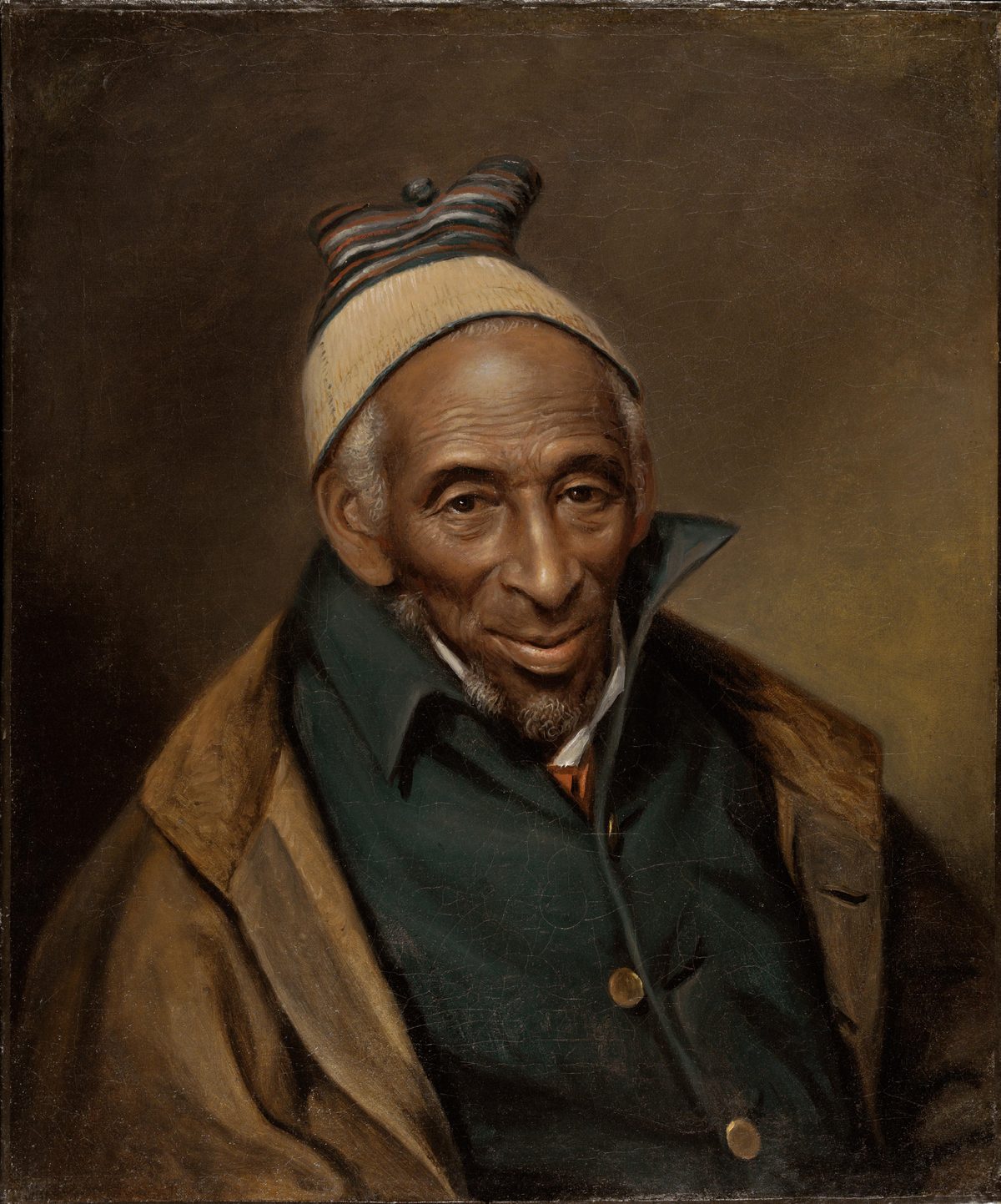
Yarrow Mamout purchased freedom and was painted by Charles Willson Peale in 1819 as a free, property-owning Muslim in the capital. Abd al-Rahman Ibrahima, a Fula prince, was freed in 1828 after the Sultan of Morocco intervened.
Revolutionary War muster rolls carry names like Bampett Muhamed and Yusuf Ben Ali — documented by the Smithsonian as African Muslims who fought in the founding struggle. The inference rests on the names and surrounding records; as with much enslaved-era history, the individuals left no testimony of their own. NMAAHC — African Muslims in Early America
Much of American Muslim institutional life — the schools, the mosque communities, the service networks — was built by women whose names the record kept less carefully than the buildings they raised. Here is some of what the record does hold.
Sylviane Diouf's scholarship documents enslaved Muslim women sustaining prayer, fasting, dietary law, and Muslim names under bondage — often the ones who carried practice across generations. Far fewer manuscripts survive from women than from men like Omar ibn Said, largely because access to Arabic literacy differed; the gap in the archive is itself part of the history, and we name it rather than paper over it.
When Detroit authorities treated her children's absence from public school as truancy in the 1930s — with prosecutions in both Detroit and Chicago — Clara Muhammad ran the movement's independent University of Islam schools instead, teaching the first classes herself: an act of educational self-determination decades ahead of the homeschool movement. Her son W. Deen Mohammed renamed the network the Sister Clara Muhammad Schools after he assumed leadership in 1975; roughly 75 schools have carried her name across the country, among the oldest Islamic educational institutions in America.
The enslaved Fula scholar Bilali Muhammad, whose Arabic prayer manual survives at the University of Georgia, was the father of a large Muslim family on Sapelo Island — daughters remembered by name as Magret, Bentoo, Chaalut, Medina, Yaruba, Fatima, and Hestuh, with his wife Phoebe. We know their names because his granddaughters, Katie Brown and Shad Hall, described their grandmother's and great-aunts' prayer — prayer beads, fixed hours facing east, the ritual "saraka" cakes of rice and honey — to interviewers for the Georgia Writers' Project in the 1930s. That is the honest shape of this record: not a plantation ledger, but family memory, carried two generations and captured just before it could be lost.
A Lebanese-American organizer born in South Dakota, Aliya Hassen spent six decades building Muslim and Arab-American civic life — founding women's organizations, writing against stereotypes of Muslim women using Islamic texts, befriending Malcolm X during his turn to Sunni Islam, and helping lead ACCESS in Dearborn, today the largest Arab-American human-services nonprofit in the country. Her papers are preserved at the University of Michigan's Bentley Historical Library and the Arab American National Museum.
Azizah al-Hibri became the first Muslim woman law professor in the United States, founded KARAMAH: Muslim Women Lawyers for Human Rights, and served as a presidential appointee on the U.S. Commission on International Religious Freedom. Ingrid Mattson — a Canadian-American convert and Islamic studies scholar — was elected president of the Islamic Society of North America in 2006, the first woman and first convert to lead the largest Muslim umbrella organization in North America.
The same Greater Syria migration that raised mosques at Ross, North Dakota (1929) and Cedar Rapids, Iowa (1934) reached the Canadian prairies in the same generation. In Edmonton, Lebanese Muslim women led by Hilwie Hamdon organized teas, dinners, and bazaars, negotiated land with the mayor, and funded Al Rashid Mosque (1938) — Canada's first purpose-built mosque. The Canadian Encyclopedia and municipal history projects document her leadership; the site includes her because the prairie story is a single border-crossing wave, not two separate national myths. In Cedar Rapids, the pattern ran the other direction: Harvard's Pluralism Project documents that the women organized first — forming a social club — and then used it to push the men into the fundraising that built the Mother Mosque. U.S. Midwestern mosque communities of the same era likewise rested on women's organizing; Sally Howell's Old Islam in Detroit recovers that everyday institutional labor from the archives.
The 2020 U.S. Mosque Survey — the same Bagby-led count that found 2,769 mosques nationwide — also tracked women's institutional role directly. By 2020, 67% of mosques had women on their governing board, up from 59% in 2010 and 50% in 2000 (83% among majority-African-American mosques, the highest of any group tracked); 55% had a dedicated women's group, up from 32% a decade earlier. The same survey is candid about what hasn't caught up: a majority of mosques, 52%, still scored only fair or poor on a women-friendliness measure, even as the excellent-or-good share rose from 37% to 49%. We report both halves of that finding.
On June 15, 2023, the Senate confirmed Nusrat Choudhury, 50–49, to the U.S. District Court for the Eastern District of New York — the first Muslim woman, and first Bangladeshi-American, confirmed to a federal judgeship in U.S. history. Choudhury had served as deputy director of the ACLU's Racial Justice Program before her 2022 nomination by President Biden.
Fencer Ibtihaj Muhammad became the first American woman to compete at the Olympics in a hijab (Rio 2016) and won a bronze medal in the team sabre event. Her public career made visible a thread already present in American Muslim life: women competing, coaching, and building institutions in full view of the national record.
The thread continues elsewhere on this page: the women who organized the early mosque communities of the Midwest (First Mosques), culture and sport (Culture), and the first Muslim women in Congress (Citizenship).
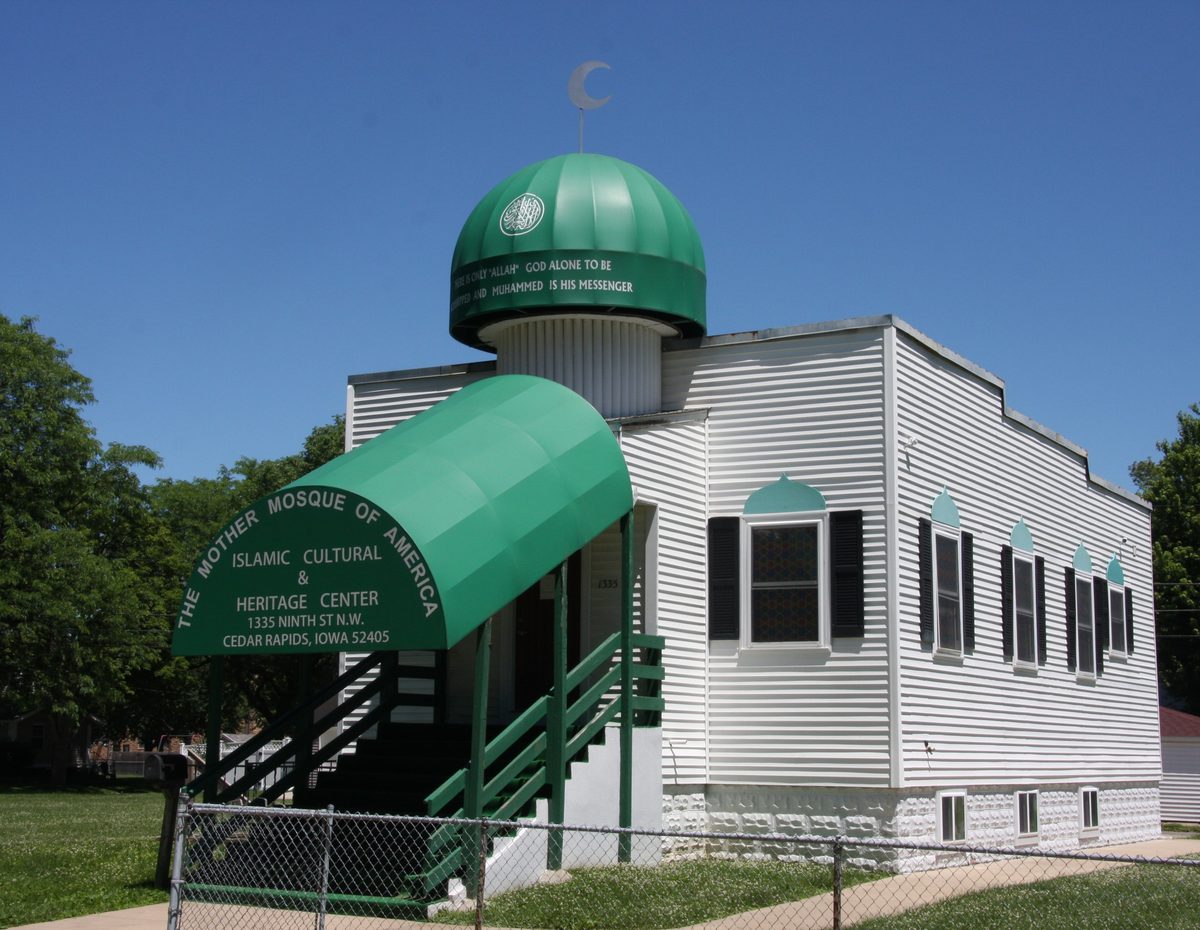
The oldest surviving purpose-built mosque in North America, completed February 15, 1934 by a Syrian-Lebanese community during the Great Depression (NPS). The Islamic Council of Iowa repurchased and renovated it in the early 1990s after a period of disuse. Listed on the National Register of Historic Places on May 15, 1996 (NRHP 96000516, as "Moslem Temple"). In 1948 the same network founded the first Muslim National Cemetery in Cedar Rapids — donations associated with the Aossey family — which served as a burial ground for much of the Midwest; NPS records that Abdallah Ingram later helped the U.S. military recognize Islam so Muslim service members would no longer be buried as atheists.
Built by Syrian-Lebanese homesteaders who took up farmland under the Homestead Acts. Generally credited as the first purpose-built mosque in the U.S. It fell into ruin, was demolished in 1979, and a commemorative mosque was rebuilt on the site in 2005. Evidence that Muslim America began in the rural West, not only in coastal cities.
The title of "first mosque" depends on definition. Oldest surviving purpose-built: Cedar Rapids (1934). First purpose-built: Ross, ND (1929). Earliest congregations in converted spaces predate both, though sources disagree on exact dates — the Harvard Pluralism Project lists early sites in Biddeford ME (1915), Ross ND (1920), Highland Park MI (1923), and Michigan City IN (1925). We show the disagreement rather than pick one answer.
Bilali Muhammad's Sapelo Island community — and its connection to the ring shout — is discussed in Lives of Faith above. Scholars have also proposed a further musical thread:
Enslaved West African Muslims literate in Arabic produced some of the earliest surviving Arabic-language documents written in North America — autobiography, Qur'anic verse, and Islamic legal text. Omar ibn Said's 1831 autobiography and Bilali Muhammad's 13-page legal manuscript are the best known. Runaway advertisements sometimes identified enslaved people specifically by their ability to write Arabic.
Historian Sylviane Diouf argues that the melismatic vocal style of enslaved field hollers — like the Mississippi "Levee Camp Holler" — echoes the patterns of Qur'anic recitation and the call to prayer, feeding into the blues. Ethnomusicologists including Gerhard Kubik have explored this West African Islamic influence. Critics note the link is suggestive rather than proven. We present it as a compelling, debated hypothesis.
Historical patterns of participation — not a program for today's contests. Each card is a documented civic practice from the American record; sources sit beside the claims. No contemporary campaigns or parties appear here.
Article VI of the Constitution bars any religious test for federal office. At the North Carolina ratifying convention (1788), Anti-Federalists feared "Mahometans" might hold office; Federalists defended the clause as the price of religious freedom. Later ceremonial oaths — including Keith Ellison's 2007 use of Jefferson's Qur'an — sit in that long constitutional tradition. The lesson is procedural: belonging tracked the document, not a single faith.
From Bosnian mutual-aid societies in early Chicago to prairie mosque boards, Dearborn human-services networks, and ICNA Relief pantries, Muslim Americans organized the way Tocqueville described American democracy working: private associations solving public needs. The pattern is institutional history — schools, clinics, reentry programs — not electoral messaging.
Yemeni farmworker Nagi Daifallah served as a United Farm Workers strike captain in the San Joaquin Valley, organizing in Arabic, Spanish, and English. He was killed by a Kern County sheriff's deputy during the 1973 grape strike; thousands marched at his Delano funeral with César Chávez present. The UFW's own memorial frames his work as multiethnic labor solidarity — a civic lesson about who built California's agriculture.
Omar ibn Said, Bilali Muhammad, Ayuba Suleiman Diallo, and others carried West African Qur'anic schooling into American bondage. Their Arabic manuscripts — held today at the Library of Congress and the University of Georgia — document intellectual continuity under enslavement. The civic lesson is archival: the record of who could read and write reshapes whose mind the republic remembers.
Classroom versions of these threads live in the educator toolkit. Primary texts sit in Sources and Documents.
American Muslims have led at the frontiers of science and medicine — from Nobel-winning chemistry to the top of the nation's health agencies.
Egyptian-American chemist Ahmed Zewail won the 1999 Nobel Prize in Chemistry for femtochemistry — using ultrafast laser pulses to observe chemical reactions as they happen, atom by atom. Based at Caltech, he was the first Arab and first Egyptian to win a science Nobel. President Obama named him among the first U.S. Science Envoys in 2009.
Algerian-American radiologist Elias Zerhouni served as the 15th director of the National Institutes of Health (2002–2008) — the first immigrant to lead the agency. A pioneer of MRI cardiac-tagging and CT imaging techniques, he later served as a U.S. presidential science envoy. He has described his medical work as connected to his faith.
The Bangladeshi-American structural engineer invented the tubular systems that made the modern skyscraper possible — the trussed tube of Chicago's John Hancock Center and the bundled tube of the Sears (now Willis) Tower, the world's tallest building from 1973 to 1998. An early champion of computer-aided design, he has been called the greatest structural engineer of the twentieth century.
Iranian-American engineer and entrepreneur Anousheh Ansari became the first Muslim woman and the first person of Iranian descent in space, spending eight days aboard the International Space Station in September 2006. Co-founder of the telecommunications firm Prodea Systems, she is enshrined in the International Space Hall of Fame.
Medicine has long been a field of prominent American Muslim contribution — as physicians, researchers, and public-health leaders. H.Res.276, the congressional resolution recognizing American Muslim contributions, specifically names figures in medicine and science among those who have shaped the nation. Muslim physicians serve communities across the country, including in underserved areas.
A short marker, not a catalog — a few figures who show the thread reaches the present in film, music, and sport.
First Muslim actor to win an Academy Award (Moonlight, 2017); won again for Green Book in 2019.
Sunni rapper and actor whose 1999 album Black on Both Sides opens with Bismillah ar-Rahman ar-Raheem. Islam has shaped Black American music for generations.
The NBA’s all-time leading scorer for nearly four decades and a two-time champion who fasted mid-season through Ramadan.
First American to compete at the Olympics in hijab and first Muslim-American woman to win an Olympic medal.
The sons of the Muslim Turkish ambassador hosted integrated jazz sessions at the D.C. embassy in defiance of segregation. Ahmet went on to found Atlantic Records in 1947 — Ray Charles, Aretha Franklin, Led Zeppelin — and co-found the Rock and Roll Hall of Fame.
Muslim communities took root across the country — in mill towns, on prairies, in port cities, and on Georgia's sea islands. Switch layers to see the historic roots, the communities of today, the place names, and explorer-route markers (Estevanico, 1528–1539) — or trace the migration waves that connected them.
Open the full field guide of landmarks →Bilali Muhammad and a community of enslaved West African Muslims practiced openly in the early 1800s; his 13-page Arabic legal manuscript survives.
Arab and South Asian Muslims were drawn to Detroit-area auto work in the early 20th century. A purpose-built mosque served Highland Park as early as the 1920s; Dearborn's community grew around Ford's River Rouge plant and is today one of the most concentrated Arab and Muslim populations in the United States.
Historian Vivek Bald documents Bengali Muslim sailors who left British ships in port cities in the late 19th and early 20th centuries. Facing restrictive immigration law, many married African American and Puerto Rican women and wove into existing neighborhoods, forming some of the earliest South Asian Muslim communities in the country.
Near Ross, Syrian-Lebanese Muslim homesteaders farmed under the Homestead Acts and built a mosque in 1929. A cemetery with Arabic-inscribed headstones still remains.
Emir Abdelkader (1808–1883) — Algerian Sufi scholar, resistance leader against French colonization, and later protector of thousands of Christians during the 1860 Damascus violence — became a global symbol of tolerance. In 1846, lawyer Timothy Davis named a new Iowa settlement in his honor; Elkader, Clayton County, is a rare U.S. city named for an Arab and Muslim figure. Abdelkader received a gift of pistols from the US president (inscribed 1860, during Buchanan's term; often popularly attributed to Lincoln). Elkader and Mascara, Algeria have been sister cities since 1984.
Some of the first Yemeni immigrants arrived in Western New York around 1920, drawn to the steel and automotive plants south of Buffalo. Settling in Lackawanna close to their work and mosques, they built one of the oldest and largest Yemeni communities in the United States — steelworkers by day, a congregation that has anchored the city's First Ward for a century.
After the 1979 Soviet invasion sent millions of Afghans into exile, refugees concentrated in Fremont's Centerville district — mosque, restaurants, food stores, and bookstores — making the Bay Area home to the largest Afghan American community in the country. A new generation arrived after the fall of Kabul in 2021.
Cham Muslims — displaced from Cambodia and Vietnam by war and the Khmer Rouge, which targeted them as a Muslim minority — reached Seattle in 1978 and Santa Ana's Minnie Street apartments as fifteen refugee families. Santa Ana's community grew into the Islamic Center of Santa Ana (2017), one of the few Cham mosques in the country — and, through the Taco Trucks at Every Mosque gatherings, a home for Latino Muslims too.
Unlike the Midwest prairie mosques of the 1920s–30s or California's 1947 Sacramento mosque, the Pacific Northwest has no major pre-1950 purpose-built mosque or NRHP Muslim landmark comparable to Ross, Cedar Rapids, or Sapelo. Documented institutional life arrives later: student and immigrant congregations after mid-century immigration reform; Cham Muslim refugees in Seattle from 1978; house-based and purpose-built centers in the Portland metro from the late 1970s–80s (among them Masjid As-Saber / Islamic Center of Portland, 1979). The absence of early landmarks is itself part of the map — not a claim that no Muslims passed through, but that the archival and built record for this region is thinner before the postwar era. Submissions of verified pre-1950 markers or cemeteries are welcome.
This site's story is American — but the record crosses both borders. Here are the documented crossings, and only those.
The Spanish Crown restricted emigration to the Americas to those who could prove generations of Catholic ancestry — precisely because it feared Muslims and Moriscos would come. They came anyway: roughly a hundred surviving court and Inquisition cases document Muslims and Moriscos living in colonial Spanish America. Among the earliest people of North African Muslim-world background documented in the future United States is the Moroccan-born Estevanico (Azemmour), who crossed in through New Spain — today's Mexico — after the Narváez disaster (see Deep Roots for baptism and source limits).
See Estevanico in Deep Roots →The same Greater Syria migration that built the mosques of Ross, North Dakota (1929) and Cedar Rapids, Iowa (1934) reached the Canadian prairies in the same generation: Al Rashid Mosque in Edmonton — Canada's first, raised in 1938 through the organizing of Lebanese Muslim women led by Hilwie Hamdon — completed a trio of prairie mosques built within a single decade on both sides of one border.
See the North Dakota prairie →The fuller Muslim histories of Canada and Mexico are their own national stories, with their own archives and anniversaries — beyond this site's scope, and deserving of their own telling.
Seven things many people assume — and what the documented record actually shows. Tap any card to turn it over.
Every claim here is documented in the sections above, each with its own citation. Follow a card’s link to read the record for yourself.
A site built on evidence cannot show only the welcome. The constitutional promise argued in 1788 has been tested since — and the record of those tests was kept by courts, journalists, and the government itself. We cite that record the same way we cite everything else.
The FBI's own hate-crime statistics recorded anti-Muslim incidents rising from 28 in 2000 to 481 in 2001 — a roughly seventeen-fold spike. The Justice Department's Civil Rights Division opened a dedicated initiative against the backlash, investigating hundreds of incidents of violence, threats, and vandalism against Muslims, Arabs, Sikhs, and South Asians.
The Associated Press won the 2012 Pulitzer Prize for documenting the NYPD's secret surveillance of Muslim daily life — mosques, cafes, student groups — that produced no terrorism leads. The unit was disbanded in 2014, and in the Raza and Handschu settlements the city accepted court-supervised safeguards against investigations based on religion.
The travel-restriction policy went through three versions — Executive Order 13769 (Jan. 2017), the revised Executive Order 13780 (Mar. 2017), then Proclamation 9645 (Sept. 2017) — before the Supreme Court ruled specifically on the Proclamation in Trump v. Hawaii, upholding it 5–4, and in the same opinion formally repudiating Korematsu, the 1944 internment case, as 'gravely wrong the day it was decided.' Justice Sotomayor's dissent read the record as religious animus. As elsewhere on this site, where the record disagrees, we show the disagreement.
Correction is part of the record too — a disbanded unit, a court-supervised settlement, a repudiated precedent. That is the system the 1788 debate built being used. See the myths the record answers · read Methods & Ethics
The most durable way past suspicion is a real encounter. Here are four honest, low-key ways to turn what you’ve read into something lived — no conversion, no politics, just contact with the record and with neighbors.
Skip the commentary and go to the record itself. Read Omar ibn Said's 1831 autobiography — the only Arabic memoir by an enslaved American — at the Library of Congress, in his own hand. Then go deeper with the Scholars' Bookshelf on our Sources page: Spellberg, Diouf, GhaneaBassiri, and the rest of the canonical scholarship.
Many American mosques hold public open-house days — tea, a tour, and questions welcome. Groups like the Islamic Networks Group run 'Meet Your Muslim Neighbors' events across the country.
Every section here is standards-aware and sourced. The educator toolkit turns the timeline, the exchange of ideas, and the founding debates into ready discussion prompts and lesson plans.
Pick the fact that surprised you most and pass it on with its source attached. A single well-documented story, shared honestly, does more than any argument.
Threads of Connection documents the American Muslim story as an integral part of the American story, timed to the nation's 250th anniversary. Every claim on this site carries its source. Where historians disagree, we show the disagreement rather than pick an answer. It takes no partisan side: the through-line here is ideas, liberty, service, and enterprise — the load-bearing threads of the Republic itself. The goal is a record that is accurate, transparent, and useful — history you can check.
This project is built independently by Saeb (michigans.me) — unaffiliated with any organization, campaign, or institution. It's offered as an open resource — content is licensed CC BY 4.0 and code MIT, so any educational or civic institution interested in stewarding bridge-building may take this and run with it. Document images are public-domain scans credited in place; decorative artwork (the hero and social-preview images) is illustrative, not archival. Have a source to add or correct? Every submission is reviewed against the source before publication. Read Methods & Ethics →
This is a living record, not a closed canon. See update policy and project updates.
Every submission is checked against the cited record before anything changes on the site. Prefer primary documents, peer-reviewed work, or institutional pages. Broken links are replaced only with independently verified URLs.
Email hello@usmuslim.org